SMOG: A Simple Habit That Helps New Drivers Make Safer Moves
SMOG Is More Than an Acronym
One of the first habits we introduce in the car is SMOG.
SMOG stands for Signal, Mirrors, Over the Shoulder, Go.
The rule is pretty simple:
Anytime you move the vehicle left or right, you need to SMOG.
Changing lanes. Making a turn. Pulling up to a curb. Leaving the curb. Pulling into a parking space. Leaving a parking space.
If the vehicle is moving left or right, you SMOG.
The only time you aren't using SMOG is when you're driving straight.
That's one of the reasons we spend so much time on it in the car. It's also something you'll use over and over again on the Minnesota road test. Think about how many times you'll turn, park, change lanes, pull up to a curb, or leave a curb during a drive. SMOG keeps coming back.
But there's more to SMOG than remembering four letters.
We want students to understand why they're doing it.
Your signal tells everyone around you what you're about to do. It makes you predictable.
Then you need to make sure it's safe to make that move.
That's where your mirrors and over-the-shoulder check come in. You're looking for vehicles, pedestrians, bicyclists, or anything else that could create a potential risk before you move the vehicle.
It's really that simple.
Let everyone know what you're about to do. Make sure it's safe. Then move the vehicle.
What Does SMOG Mean?
SMOG stands for Signal, Mirrors, Over the Shoulder, Go.
Each step has a purpose.
Signal
Your signal is how you communicate with everyone around you. It lets other drivers, pedestrians, and bicyclists know what you're planning to do before you do it.
Your signal should be on at least 100 feet before you turn or move the vehicle left or right. Give everyone around you time to see your signal and know what you're about to do.
Mirrors
Next, check your rearview mirror and the side mirror in the direction you're moving.
You're checking to see what's happening behind you and on the side you're about to move toward.
Is there another vehicle there? Is someone coming up alongside you? Is there anything that could make your move unsafe?
Over the Shoulder
This is where we check the blind spot.
Something can be close enough to your vehicle that you can no longer see it in your mirrors, but not close enough for you to see it out of the corner of your eye.
That's your blind spot.
When you look over your shoulder, you're not looking backward. You're taking a quick look into your blind spot to make sure nothing is there before you move the vehicle.
Go
Go doesn't automatically mean you move.
You've signaled, checked your mirrors, and looked into your blind spot. Now you need to decide if it's safe to move.
If it's safe, go.
If it's not, wait.
SMOG Helps Keep You Predictable and Avoid Risk
One of the reasons we spend so much time on SMOG is because it does two really important things.
It helps make you predictable, and it helps you avoid risk.
Your signal tells everyone around you what you're about to do.
You're going to turn.
You're going to change lanes.
You're going to pull over.
You're going to leave the curb.
When other drivers, pedestrians, and bicyclists know what you're about to do, you become more predictable.
But telling everyone what you're going to do is only the first part.
You still need to make sure it's safe.
That's why we check our mirrors and look over our shoulder. We're checking what's happening around the vehicle before we move left or right.
Is there another vehicle next to us?
Is someone coming up alongside us?
Is there a pedestrian or bicyclist we need to be aware of?
Is there anything that could make our move unsafe?
Continue Reading: Why Looking Farther Ahead Makes You a Better Driver
https://blog.readysetdrivemn.com/lookingahead
That's the why behind SMOG.
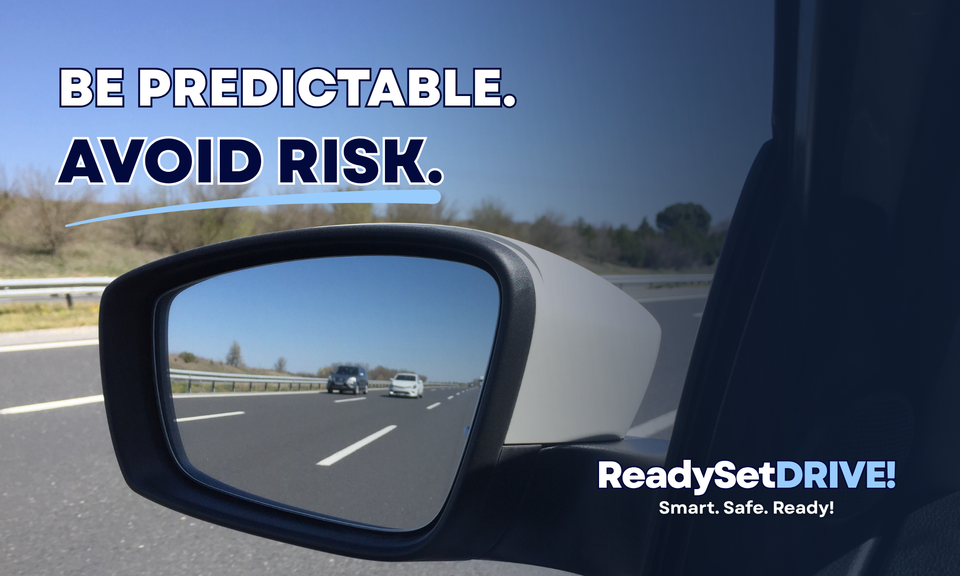
Be predictable. Avoid risk.
Let everyone around you know what you're about to do. Make sure it's safe. Then make your move.
Use SMOG Every Time
The best way to make SMOG a habit is to use it every time you move the vehicle left or right.
At first, you may have to think about each step.
Signal. Mirrors. Over the Shoulder. Go.
That's okay. You're learning something new.
In the car, we sometimes compare SMOG to learning a dance routine, running a set play for your team, or rehearsing a scene in a play. At first, you have to think about what comes next. But the more you practice it, the more natural it becomes.
SMOG works the same way.
You practice the same steps, in the same order, over and over again.
But doing the steps isn't enough.
SMOG isn't about quickly going mirror, mirror, shoulder just because you know that's what comes next.
Take your time. See what's there. Process what you see.
When you check your mirrors, actually look at what's happening around you. When you look over your shoulder, actually look into your blind spot.
What did you see?
Is there a vehicle there? Is someone coming up alongside you? Is the space clear?
That's the part that matters.
The more you practice SMOG, the more automatic the routine becomes. You don't have to think about what comes next, but you still need to take the time to see and process what's around you.
Your signal goes on. You check your mirrors. You look into your blind spot. You process what you see. If it's safe, you move.
The situation may change, but the process stays the same.
The goal is for SMOG to become something you do naturally anytime you move the vehicle left or right.
SMOG and the Minnesota Road Test
There may not be another skill you use more often during the Minnesota road test than SMOG.
Think about how many times you'll move the vehicle left or right during the test.
You'll make turns. You'll change lanes. You'll pull up to and away from a curb. You'll parallel park. You'll complete a 90-degree back-in.
SMOG keeps coming back.
During the road test, the examiner is looking for two things we talk a lot about in the car: potential risks and critical errors.
A potential risk is something you do that could cause a bad situation, even if nothing happens.
A critical error means you created a dangerous situation.
SMOG helps you avoid both.
Your signal lets everyone around you know what you're about to do. Your mirrors and over-the-shoulder check help you make sure it's safe before you move the vehicle.
But remember, SMOG isn't just mirror, mirror, shoulder.
You actually need to look.
What did you see?
Is there a vehicle next to you? Is someone coming up alongside you? Is the space clear?
Take your time. See what's there. Process what you see.
Then decide if it's safe to move.
By the time you take your road test, we want SMOG to be something you do naturally because you've practiced it over and over again.
The goal isn't to SMOG because you're taking a road test. The goal is to SMOG because that's the way you drive.
Make SMOG a Driving Habit
SMOG is a simple process, but it's one of the most important habits a new driver can develop.
Anytime you move the vehicle left or right, you SMOG.
At first, you may have to think about every step. That's part of learning. The more you practice it, the more natural the routine becomes.
But remember, the goal isn't just to get faster at going through the steps.
Take your time. See what's there. Process what you see.
Your signal helps make you predictable. Your mirrors and over-the-shoulder check help you recognize potential risks and make sure it's safe before you move.
Be predictable. Avoid risk.
Practice SMOG enough that the routine becomes automatic, but never stop paying attention to what you see.
That's how SMOG becomes part of the way you drive.